
Silver’s Long-Term Upside and Short-Term Risks
Disclaimer: This article does not constitute any investment advice.
In this era of severe monetary overissuance, extreme geopolitical tensions, global instability, and the gradual depletion of resources, where resources are paramount, the future price of silver is bound to rise substantially. Such an increase may far exceed anything within people’s memory. Silver and gold are both precious metals. Both have financial attributes, both serve as stores of value, and both possess collectible value. However, the biggest difference between silver and gold is that silver has a very pronounced industrial character. In particular, silver is widely used in many high-tech industries. From a longer-term perspective, silver may have stronger support than gold, which also means that its future price fluctuations may be more intense. In short, silver remains promising in the long run but carries high short-term risk. Therefore, we should adhere to the basic principle of maintaining light positions for the long term and investing with peace of mind.
Bullish in the Long Run
Demand Side: Strong Industrial Attributes
As the Silver Institute notes, silver is an essential component in many industries. Its unique properties make it nearly impossible to substitute, and its uses span a wide range of applications. Almost every computer, mobile phone, automobile, and appliance contains silver. Owing to its high electrical conductivity and durability, silver is used to coat electrical contacts, such as those in printed circuit boards and switches. Silver ink can also be applied to non-metal surfaces to provide electrical pathways without wires. RFID chips with sprayed-on silver antennas are also replacing bar codes on many items in supermarkets and supply-chain inventories.
In today’s era of rapid growth in new energy, demand for silver is surging. Solar power, for example, requires a large amount of silver. As the Silver Institute notes, silver’s high electrical conductivity, thermal efficiency, and reflectivity enable it to capture sunlight efficiently and convert it into electricity. On average, each solar panel contains 0.643 troy ounces of silver (about 20 grams), or approximately 3.2–8 grams per square meter. Earlier researchers estimated that solar-panel production would consume 185 million ounces of silver (about 5,754.15 metric tons) by 2030. However, because the solar industry has expanded so rapidly, that forecast was soon left behind. Based on current trends, investment analysts project that silver demand from photovoltaic manufacturers will rise by nearly 170% by 2030, reaching about 273 million ounces (around 8,491.26 metric tons), accounting for roughly one-fifth of total silver demand. (Silver Institute; Boab Metals; Sprott)
In addition to solar power, demand for silver from new energy vehicles is also growing rapidly. As the Silver Institute notes, silver’s conductivity and corrosion resistance make it indispensable for electrode materials. Electric vehicles use silver in the electrical contacts of numerous onboard electronic systems. These include switches that turn the vehicle and its accessories on and off, as well as relays, circuit breakers, and fuses that control electronic circuits. Every electrical connection is activated by silver-coated contacts. As a result, each electric vehicle uses 25–50 grams of silver, about 1.5–2 times as much as a conventional internal-combustion vehicle. The automotive industry’s silver demand also includes silver alloys that help weld steel and aluminum together, as well as silver-ceramic lines used to defrost windshields. Nearly every electrical connection in an electric vehicle uses silver, and the automotive sector consumes 55 million ounces (about 1,710 metric tons) of silver per year. (Silver Institute)
In the age of AI, the development of artificial intelligence also depends on silver. After all, silver is the most conductive metal, and when chip performance and computing speed become the focus of competition, exceptionally strong conductivity becomes essential. Aerospace likewise requires large amounts of silver, playing a crucial role in everything from satellite launches to deep-space exploration. Relevant data show that a medium-sized satellite requires 20 to 50 ounces of silver in its internal components, while a large communications satellite may use 75 ounces or more. More importantly, once this silver is sent into space, most of it cannot be recovered. In total, at least 130,000 ounces of silver have already been sent into space and can no longer be recycled.
Supply Side
Global silver mine production peaked around 2016 and has generally trended downward since then. In addition, current global silver reserves would, in purely arithmetic terms, be sufficient for only about 23.5 years of mining at recent production rates. (Silver Institute, World Silver Survey 2025; U.S. Geological Survey, Mineral Commodity Summaries 2026; Visual Capitalist, based on USGS data)
Not all silver is mined directly from primary silver deposits. In fact, most mined silver is produced as a by-product of other metals. According to the Silver Institute, more than 70% of mined silver output comes from lead-zinc, copper, and gold mines, with lead-zinc accounting for the largest share. In the 2022 market data cited by the Institute, 72% of mined silver was produced as a by-product, while silver from copper mines alone accounted for 26% of total mine production. This means that silver supply depends not only on silver itself, but also on the production cycles of other base metals. If copper output declines, for example, silver output as a by-product may also fall. (Silver Institute, World Silver Survey 2023; Silver Institute, Factors that Determine the Silver Price)
Taken together, these factors help explain why silver shortages are no longer a new phenomenon. According to the Silver Institute, the global silver market recorded a structural deficit of 148.9 million ounces in 2024, and the combined deficit for 2021–2024 reached 678 million ounces, equivalent to roughly ten months of global mine supply in 2024. The Institute later noted that 2025 would mark the fifth consecutive annual deficit, and that the cumulative deficit for 2021–2025 would reach almost 820 million ounces. (Silver Institute, Silver Industrial Demand Reached a Record 680.5 Moz in 2024; Silver Institute, The Silver Market is on Course for Fifth Successive Structural Market Deficit)
The Silver Institute has also stated that the silver market is expected to remain in deficit in 2026, which would make it the sixth consecutive annual deficit. Against this backdrop, exchange inventories have remained under pressure. In China, according to Wind data cited by Jiemian News and republished by East Money, Shanghai Gold Exchange silver inventories fell to 715.875 metric tons in the week of November 24, 2025, the lowest level since July 3, 2016. (Silver Institute, Global Silver Investment to Remain Strong in 2026 Against the Backdrop of a Sixth Consecutive Annual Market Deficit; East Money / Jiemian News)
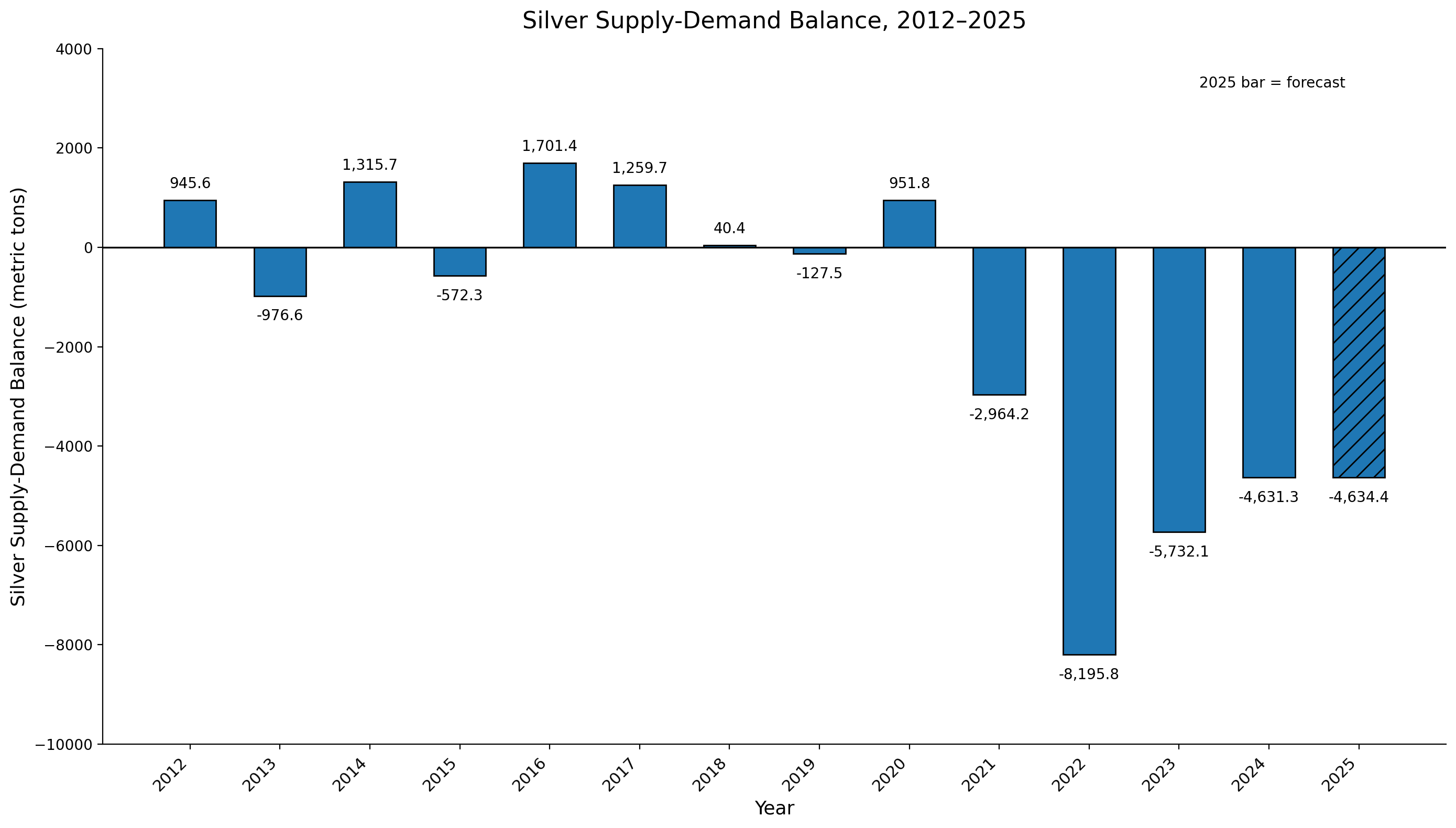
Figure 1. Silver supply-demand balance, 2012–2025. Data source: The Silver Institute.
High Short-Term Risk
Even if the long-term outlook remains favorable, short-term risks cannot be ignored. First, exchanges have made significant policy adjustments by raising margin requirements on gold, silver, and other metal futures contracts. The logic is straightforward: prices have climbed too quickly, leverage has become excessive, and without tighter controls, any shock could trigger forced liquidations and place heavy strain on the clearing system. In this sense, the move is both a precautionary measure by the exchanges and a deliberate attempt to cool the precious-metals market. Second, the stronger an asset’s momentum, the more likely it is to attract large players seeking to influence price movements. In addition, if a war were to break out, expectations for silver’s industrial demand could weaken in the short term, which would in turn weigh on silver prices.
Conclusion
All in all, in today’s resource-driven world, silver’s industrial role—beyond its monetary and financial attributes—provides a firmer foundation for its future price. Over the longer run, silver is likely to outperform gold, though that also implies greater volatility. In other words, silver looks promising over the long term, but the short-term risks remain high. Therefore, the best approach is to stick to the basic principle of maintaining light positions for the long term and investing with peace of mind.
The cover image in this article was taken aboard a Royal Caribbean cruise ship.
Silver’s Long-Term Upside and Short-Term Risks