
Gold’s Long-Term Upside and Short-Term Risks
Disclaimer: This article does not constitute investment advice.
In an era marked by severe monetary expansion, intense geopolitical tensions, global instability, and the steady depletion of natural resources, where resources are increasingly becoming the ultimate source of value, gold is destined to rise substantially over the long term. The magnitude of that rise may well exceed anything people can judge from past experience. That broad trend is unlikely to change. In the short run, however, factors such as short squeezes triggered by higher futures margin requirements and deliberate market intervention by large capital can create enormous volatility and significant near-term risk. In short, gold remains a long-term bullish asset, but it also carries considerable short-term risk. We should therefore adhere to the basic principle of keeping positions light, investing for the long term, and investing with peace of mind.
Bullish Over the Long Term
Demand Side: The Dual Tailwinds of Monetary Policy and Geopolitics
Monetary Policy
After the COVID-19 pandemic, major central banks around the world aggressively expanded the money supply in an effort to support households, rescue businesses, and maintain loose financial conditions. This collective wave of monetary easing led to a significant erosion in the value of fiat currencies. And who understands monetary overexpansion better than anyone else? The central banks themselves. In recent years, central banks around the world have been actively accumulating gold. According to data released by the World Gold Council (WGC), global central bank net gold purchases from 2020 to 2025 are shown in the chart below.
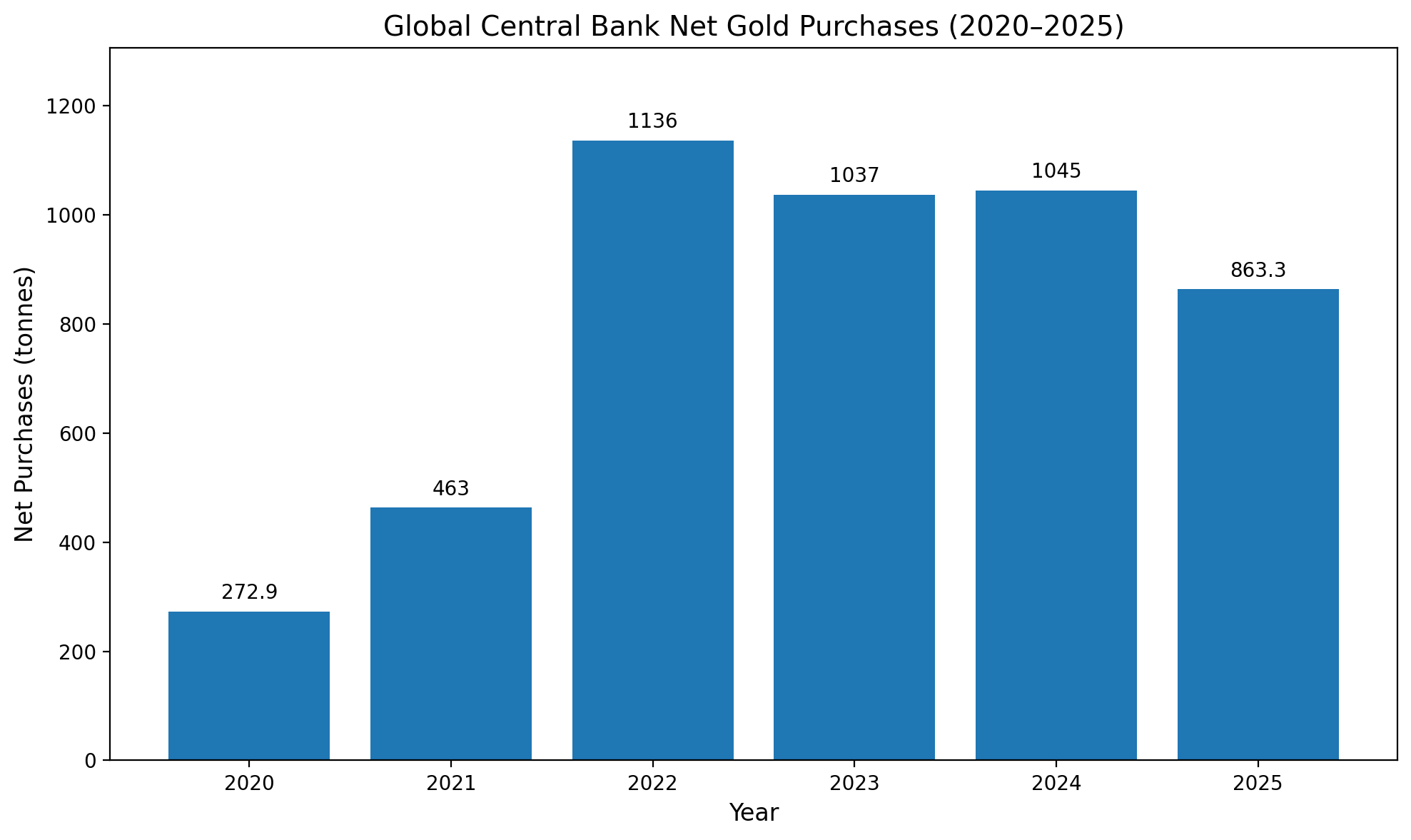
The People’s Bank of China, in particular, has increased its gold holdings for 14 consecutive months since November 2024. Central banks are clearly not acting blindly. If gold had no upside left at all, why would they continue to add to their reserves?
Geopolitics
Geopolitical tensions are not only intensifying, but have also become increasingly intertwined with energy and shipping risks. The United States has moved to block Venezuelan tankers; Ukraine has, for the first time, attacked Russia’s shadow fleet in the Mediterranean; and tensions between the United States and Iran continue to escalate. As a result, energy prices, transportation costs, market stability, and global supply chains are all facing far-reaching consequences. Meanwhile, after a nine-month gap, China has once again launched large-scale military exercises encircling Taiwan, further heightening tensions in the region. Since December, China has also reportedly been stockpiling strategic materials on a large scale, including coking coal imported from Mongolia and crude oil from the Middle East. All of these developments are important forces driving sharp gains in gold and silver. When a country is preparing for military action, it often stockpiles gold in advance; and when a country is continuously accumulating large amounts of gold, it may also be preparing for potential future conflict.
Supply Side
As resources become depleted and mining costs continue to rise sharply, the scarcity of gold is increasing as well.
Moving Toward Depletion
According to USGS 2026, global gold reserves amount to approximately 66,000 tonnes. Based on global mine production of roughly 3,300 tonnes in 2025, that would imply only about 20 years of mineable supply remaining at the current pace.
Persistently High Mining Costs
One major reason gold mining remains expensive is that inflation has intensified in many resource-rich countries, driving up labor costs and electricity prices and, in turn, increasing the costs of extraction, transportation, and exploration. At the same time, the world’s easiest-to-mine and most mature deposits, namely older mines, are being depleted. Many undeveloped gold resources are concentrated in politically unstable regions such as West Africa. But new mines do not automatically translate into greater gold supply, because new mines come with new costs. Mining gold deep in the African jungle requires enormous upfront investment in electricity, roads, and other infrastructure, all of which means very high capital expenditure. In addition, the environmental cost of gold mining is rising steadily. Australia is a good example. As early as the beginning of the twentieth century, it had already placed great emphasis on environmental protection in the mining sector. Mining companies must pass multiple layers of approval before extraction can begin, and once mining is completed they are required to carry out land rehabilitation. After the rehabilitation work is finished, the relevant resource authorities inspect the site. Only if the restoration meets the required standard will the environmental bond be returned to the mining license holder; otherwise, the deposit is forfeited.
All of this shows that the depletion of gold resources, declining ore grades, and rising mining costs will remain important structural forces supporting higher gold prices over the long term.
High Short-Term Risk
Although the long-term trend remains intact, short-term risks still need to be worked off. First, exchanges have introduced major policy adjustments by raising margin requirements across gold, silver, and other metal futures contracts. The reason is simple: prices have risen too quickly, leverage has built up excessively, and without intervention, any disruption could trigger concentrated liquidations and put severe stress on the clearing system. This is both a defensive move by the exchanges and a deliberate effort to cool the precious metals market. Second, the stronger the momentum in an asset, the more likely it is that major capital will try to influence the market intentionally. In addition, if war were to break out, it could fuel inflation expectations in the United States, reduce expectations of Federal Reserve rate cuts, and thereby raise the opportunity cost of holding gold, potentially leading to a sizable correction.
Conclusion
In summary, demand for gold continues to rise due to factors such as severe monetary expansion and heightened geopolitical tension. At the same time, the ongoing depletion of gold resources, the decline in ore grades, and the continued increase in mining costs are making gold ever scarcer. For that reason, gold is likely to see substantial gains over the long term. In the short run, however, the risks remain elevated, and investors should adhere to the basic principle of keeping positions light, investing for the long term, and investing with peace of mind.
The cover image in this article was taken at the Lake Königsee in Germany.
Gold’s Long-Term Upside and Short-Term Risks