
Introduction to Gamma Convergence
Motivation
Let $(X,d)$ be a metric space, $F, F_n: X\to \overline{\mathbb{R}}, n=1,2,\cdots$ be functionals, suppose that $x_n\in X$ minimizes $F_n$ for each $n=1,2,\cdots$, does $\lim\limits_{n\to\infty} x_n$ (if it exists) minimize any functional $F$? And in what sense does $F_n$ converge to $F$ ensure the minimizer of $F_n$ converges to minimizer of $F$?
Example 1. Let $ H_0^1((0,1);\mathbb{R})=\{u:(0,1)\to \mathbb{R}| u\in L^2,\nabla u\in L^2, u(0)=u(1)=0\} $ and functional $F: H_0^1((0,1);\mathbb{R})\to [0,+\infty]$ be defined via
$$
F(u):= \int_0^1 (u^\prime(x)^2-1)^2 dx.
$$
Define
$$
F_n(u):=\begin{cases}
F(u),& \text{if } u^\prime \text{ is constant on } (\frac{i}{2n},\frac{i+1}{2n}), i=0,1,\cdots,2n-1\\\
+\infty,& \text{otherwise}
\end{cases}
$$
and let $u_n$ be a minimizer of $F_n$ defined by
$$
u_1(x)=\begin{cases}
x,& x\in [0,\frac{1}{2})\\\
1-x,& x\in [\frac{1}{2},1]
\end{cases}, \quad u_2(x)=\begin{cases}
x,& x\in [0,\frac{1}{4})\\\
\frac{1}{2}-x& x\in [\frac{1}{4},\frac{1}{2})\\\
x-\frac{1}{2}& x\in [\frac{1}{2},\frac{3}{4})\\\
1-x,& x\in [\frac{3}{4},1]
\end{cases},\quad \cdots
$$
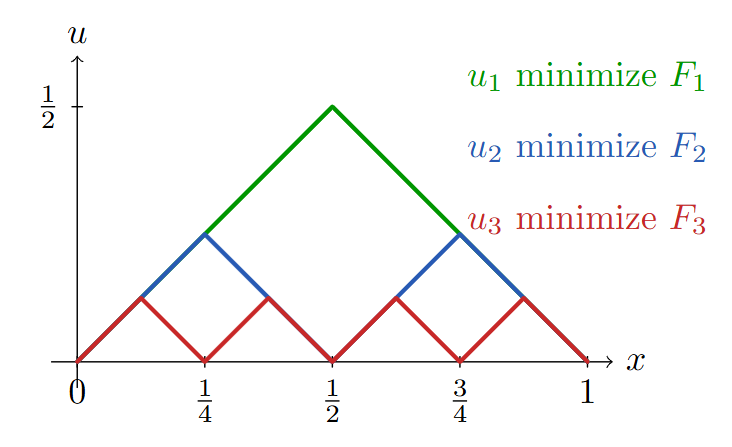
It is easy to see that
$$
F_n(u_n)=0,\quad \forall n=1,2,\cdots,
$$
and $u_n\to u\equiv 0$, but
$$
F(u)=1>0,
$$
which shows that the pointwise limit $u$ is not the minimizer of $F$. Hence, we need to find a new type of convergence to answer the above question, which motivates the definition of $\Gamma-$convergence.
$\Gamma$-convergence
Definition 1. We say that a sequence of functionals $F_n:X\to \mathbb{R}\ \Gamma-$converges to $F:X\to \mathbb{R}$, denoted by $F_n\xrightarrow{\Gamma} F$, if for all $x\in X$, we have
(i) (liminf inequality) for all $(x_n)$ converging to $x$,
$$
F(x)\le \liminf_{n\to\infty} F_n(x_n).
$$
(ii) (limsup inequality) there exists $(x_n)$ converging to $x$ such that
$$
F(x)\ge \limsup_{n\to\infty}F_n(x_n).
$$
And we say the sequence $(x_n)$ in (ii) the recovery sequence.
Example 2. Let $X=\mathbb{R}$ and $F_n(x)=\cos(nx)$, then $F_n\xrightarrow{\Gamma} F\equiv -1$.
Proposition 1. If $F_n\xrightarrow{\Gamma} F$ and $G$ is $d-$continuous, then $F_n+G\xrightarrow{\Gamma} F+G$.
Proof: We first prove (i). For all $(x_n)$ converging to $x$, by $F_n\xrightarrow{\Gamma} F$, we have
$$
F(x)\le \liminf_{n\to\infty} F_n(x_n),
$$
then
$$
F(x)+G(x)\le \liminf_{n\to\infty} F_n(x_n)+\lim_{n\to\infty} G(x_n)=\liminf_{n\to\infty} (F_n(x_n)+G(x_n))
$$
Then we prove (ii). Suppose $(x_n)$ converging to $x$ such that
$$
F(x)\ge \limsup_{n\to\infty}F_n(x_n),
$$
then
$$
F(x)+G(x)\ge \limsup_{n\to\infty}F_n(x_n)+\lim_{n\to\infty} G(x_n)=\limsup_{n\to\infty} (F_n(x_n)+G(x_n)).
$$
Hence, by the definition of $\Gamma-$convergence, $F_n+G\xrightarrow{\Gamma} F+G$.
Example 3 ($\Gamma-$limit of a constant sequence may not be itself). Consider $F_n\equiv F$ and let $\overline{F}$ be the $\Gamma-$limit of $F_n$, by liminf inequality, we have for all $x\in X$ and $x_n\to x$,
$$
\overline{F}(x)\le \liminf_{n\to\infty} F(x_n).
$$
Notice that if $F$ is not lower semi-continuous, then there exists $\overline{x}\in X$ and $\overline{x}_n\to \overline{x}$ such that
$$
\liminf_{n\to\infty} F(\overline{x}_n) \lt F(\overline{x}).
$$
Hence,
$$
\overline{F}(\overline{x})\lt F(\overline{x}),
$$
which shows that if $F$ is not lower semi-continuous, then $F$ is not the $\Gamma-$limit.
Proposition 2. If $F_n\xrightarrow{\Gamma} F$ and $F_n\xrightarrow{pointwise} G$, then $F\le G$.
Proof: By definition, we take $x_n\equiv x$ and then
$$
F(x)\le \liminf_{n\to\infty}F_n(x)=G(x).
$$
Proposition 3. If $F_n$ uniformly converge to $F$ and $F$ is lower semi-continuous, then $F_n\xrightarrow{\Gamma} F$.
Proof: We first prove (i), for all $(x_n)$ converging to $x$,
$$
\liminf_{n\to\infty} F_n(x_n)=\liminf_{n\to\infty} (F_n(x_n)-F(x_n)+F(x_n))=\liminf_{n\to\infty} (F_n(x_n)-F(x_n))+\liminf_{n\to\infty} F(x_n)\ge F(x),
$$
where the last inequality is because the uniform convergence and lower semi-continuity. Next, we prove (ii), take $x_n\equiv x$, we have
$$
\limsup_{n\to\infty} F_n(x)=\limsup_{n\to\infty} (F_n(x)-F(x)+F(x))=\limsup_{n\to\infty} (F_n(x)-F(x))+ F(x)= F(x).
$$
Convergence of Minimizer
Proposition 4. Let $F_n,F:X\to\overline{\mathbb{R}}$, then
(1) if liminf inequality is satisfied, then for all $x\in X$ and $K\subset X$ compact, we have
$$
\inf_K F\le \liminf_{n\to\infty} \inf_K F_n\ ;
$$
(2) if limsup inequality is satisfied, then for all $x\in X$ and $U\subset X$ open, we have
$$
\inf_K F\ge \limsup_{n\to\infty} \inf_U F_n\ .
$$
Proof: (1) By the definition of infimum, we can take $(\tilde{x}_n)\subset K$, such that
$$
\liminf_{n\to\infty} \inf_K F_n=\liminf_{n\to\infty} F_n(\tilde{x}_n)
$$
Because $K$ is compact, up to extraction, we obtain $\tilde{x}_{n_j}$ such that
$$
\tilde{x}_{n_j}\to\tilde{x}\in K
$$
and
$$
\liminf_{n\to\infty} \inf_K F_n=\lim_{j\to\infty} F_{n_j} (\tilde{x}_{n_j})
$$
By the liminf inequality, we obtain
$$
\inf_K F\le F(\tilde{x})\le \lim_{j\to\infty}{ F_{n_j} (\tilde{x}_{n_j})}
$$
Hence
$$
\inf_K F\le F(\tilde{x})\le \liminf_{n\to\infty} \inf_K F_n
$$
(2) For all $\delta>0$, let $(x_n)$ be a recovery sequence for $x\in U$ such that
$$
F(x)\le \inf_U F+\delta.
$$
Hence by limsup inequality
$$
\inf_U F+\delta \ge F(x)\ge \limsup_{n\to\infty} F_n(x_n)\ge \limsup_{n\to\infty} \inf_U F_n\ .
$$
According to the arbitrariness of $\delta>0$, we get
$$
\inf_K F\ge \limsup_{n\to\infty} \inf_U F_n\ .
$$
Fundamental Theorem of $\Gamma-$Convergence
Theorem 1 (Fundamental Theorem of $\Gamma-$Convergence). Let $(X,d)$ be a metric space and $\{F_n\}$ be a sequence of functionals. Assume that there exists a compact set $K\subset X$ such that
$$
\inf_K F_n = \inf_X F_n,\quad \forall n.
$$
If $F$ is the $\Gamma-$limit of $F_n$, then the minimizer of $F$ exists and
$$
\min_X F=\lim_{n\to\infty} \inf_X F_n.
$$
Moreover, if $(x_n)$ is a pre-compact sequence such that
$$
\lim_{n\to\infty} F_n(x_n)=\lim_{n\to\infty} \inf_X F_n
$$
then every limit point of $x_n$ is a minimizer of $F$.
Proof: Let $\tilde{x}$ be the point obtained in the proof of proposition 4, then we have
$$
\inf_x F \le \inf_K F\le F(\tilde{x})\le \liminf_{n\to\infty} \inf_K F_n=\liminf_{n\to\infty} \inf_X F_n\le \limsup_{n\to\infty} \inf_X F_n\le \inf_X F,
$$
where the last inequality is the limsup inequality. Hence
$$
F(\tilde{x})=\inf_X F=\lim_{n\to\infty} \inf_X F_n.
$$
Acknowledgment
The above content is summarized based on the video GSS Fall 2016 - Giovanni Gravina: An Introduction to Gamma-convergence on YouTube.
The cover image in this article was taken at Queenstown, New Zealand
Introduction to Gamma Convergence
https://handsteinwang.github.io/2026/02/16/Gamma_convergence/